Moved is not the same as received
Notes from the pipeline #1 — on handoff progression vs. handoff readiness.
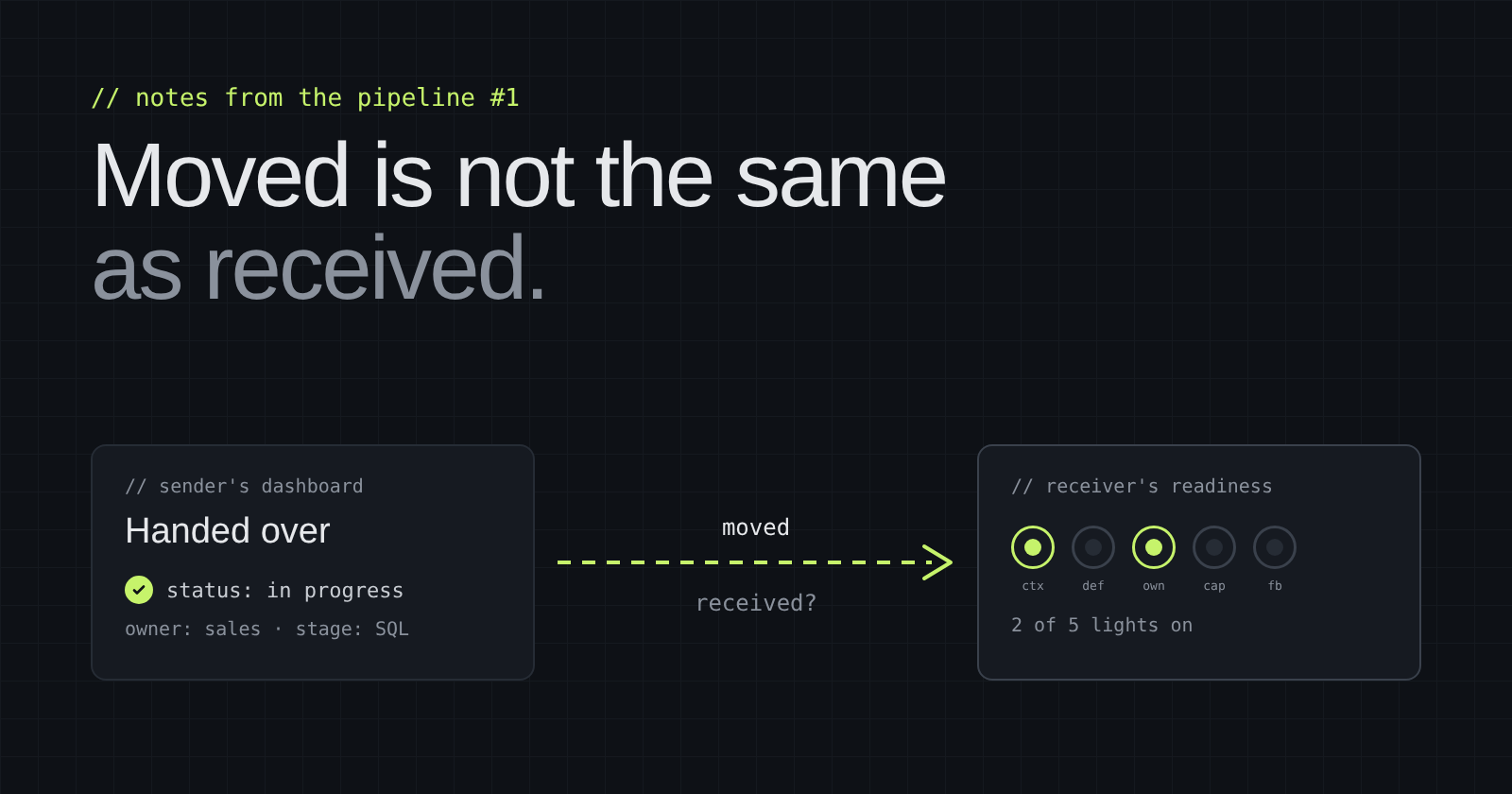
- A handoff that changes status ("moved") isn't the same as one the next team can act on ("received").
- Two layers: progression shows where the work sits; readiness shows whether the next move can actually happen.
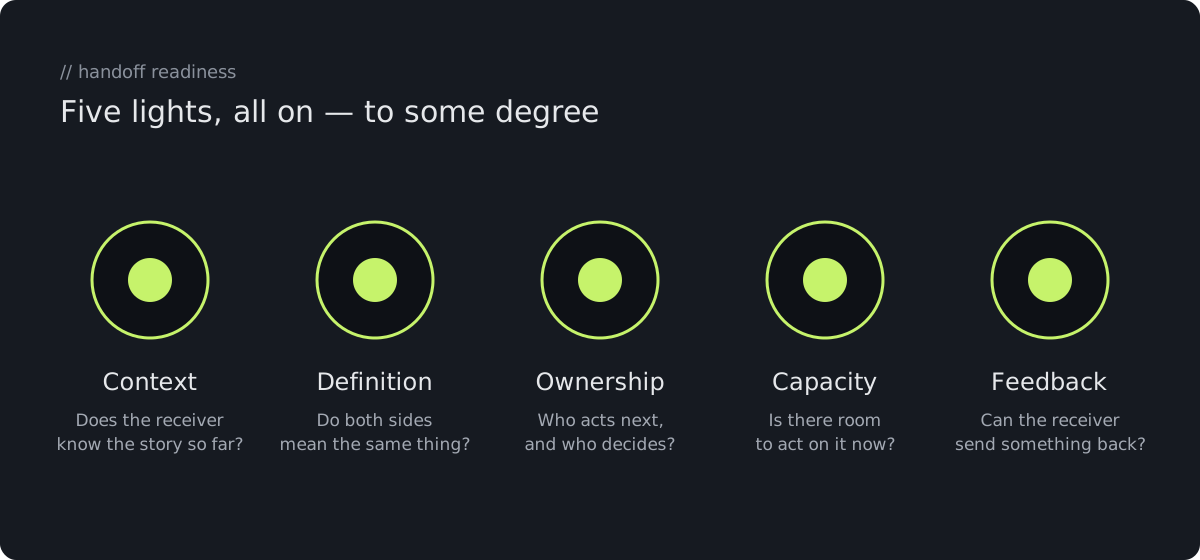
- Readiness rests on five conditions: context, definition, ownership, capacity and feedback.
- When a handoff stalls, ask which condition was missing before chasing, escalating or tightening the SLA.
- Open question: who owns readiness? Likely split — the sender owns context and definition, the receiver owns capacity and feedback.
Summary drafted with AI and reviewed by Harold Hoang.
Every pipeline has a moment we call “the handoff.”
Marketing passes a lead to Sales. A content team passes a brief to developers. Someone drags a ticket into “Ready for review.”
On the dashboard, something has moved. A status changed. A different name sits in the owner field. The funnel looks a little healthier than it did this morning.
I’ve spent a lot of my working life in the space between teams, the place where one team’s “done” becomes another team’s “to do.” And the longer I sit there, the more I notice one thing:
Moved is not the same as received.
A lead can land in Sales’ queue and still arrive with no context about why it came in. A brief can reach a developer and still mean three different things depending on who reads it. A request can sit “with Finance” for a week before anyone realizes the one document they needed was never attached.
On paper, the pipeline progressed. In practice, nothing has happened yet.
So in this first note, I want to separate two things we usually treat as one.
Two layers, not one
Handoff progression is where the work sits in the process: its status, its owner, its stage. It’s easy to see and easy to count. Most of our dashboards are built on it.
Handoff readiness is something else. My working definition:
Handoff readiness is the degree to which the receiving side has what it needs (context, shared meaning, clear ownership, capacity, and a way to respond) to act on the work without having to go back and ask.
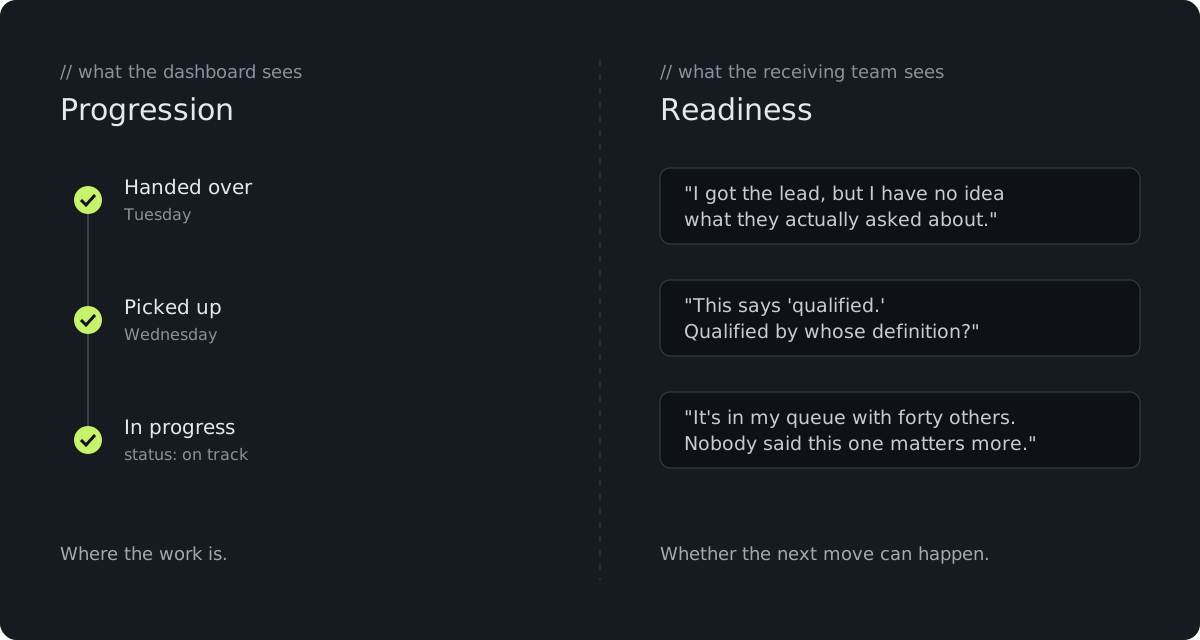
This isn’t a second funnel to draw next to the first one. The two layers answer different questions. Progression tells you where the work is. Readiness tells you whether the next move can actually happen.
Here’s how the gap shows up. The dashboard says a lead was handed over on Tuesday, picked up on Wednesday, and is now “in progress.” It looks fine.
But the person who received it might be thinking:
“I got the lead, but I have no idea what they actually asked about.”
Or:
“This says ‘qualified.’ Qualified by whose definition?”
Or:
“It’s in my queue, along with forty others, and nobody told me this one matters more.”
The work has moved a long way in terms of status. It hasn’t moved at all in terms of readiness.
Five conditions of handoff readiness
When I look at the handoffs that stall, the reasons tend to cluster around five conditions. They’re not stages to pass through in order. They’re more like five lights that all need to be on, to some degree, for the receiving team to move.
1. Context: does the receiver know the story so far?
Not just what is being passed, but why it exists, what has already been tried, and what the person on the other end of it is expecting.
A lead without context forces Sales to start the conversation from zero. A brief without context forces a developer to guess at intent. In both cases, the receiver either spends time rebuilding what the sender already knew, or acts on a guess.
“I can see what you sent. I just can’t see why.”
2. Definition: do both sides mean the same thing?
This is the quietest failure, because everyone thinks they agree. “Qualified,” “urgent,” “done,” “approved.” Each team uses these words every day, and each team learned them in a slightly different context.
When Marketing says a lead is qualified, it might mean “fits the profile.” When Sales hears it, they might hear “ready to talk about buying.” Same word, two different promises.
“It says done. Done for you, or done for me?”
3. Ownership: is it clear who acts next, and who decides?
A handoff moves the work, but it doesn’t always move the decision. Sometimes the receiver can act but not decide. Sometimes they can decide but need someone else to sign off. Sometimes nobody is quite sure, so everybody waits politely.
“I can work on this. I’m just not sure I’m allowed to say yes.”
4. Capacity: is there room to act on it now?
A handoff can be perfectly prepared and still land on a team that has no time for it this week. That isn’t a failure of the receiver. It’s a mismatch between the rhythm of the sending team and the rhythm of the receiving one.
Capacity also includes priority. If everything arrives labelled “important,” the label stops carrying information.
“I believe this matters. So do the other thirty-nine things.”
5. Feedback: can the receiver send something back?
Most handoffs are designed in one direction. Work goes forward; very little comes back. So the sender never learns that the context was thin, the definition was off, or the timing was bad. And the next handoff carries exactly the same gaps.
A handoff without a way back isn’t really a handoff. It’s a drop-off.
“I could tell you what’s missing. I just don’t know where to say it.”
What this changes
When a handoff stalls, the reflex is to chase. Follow up. Add a reminder. Tighten the SLA. Escalate.
Sometimes that’s right. But often we’re pushing on progression when the problem is readiness. We’re asking “why haven’t you moved this?” when the more useful question is:
What needed to be true for the receiving side to move, and which of those things wasn’t?
Maybe they needed context. Maybe the definition didn’t match. Maybe no one knew who decides. Maybe there was no room this week. Maybe they tried to say something was missing, and there was nowhere to say it.
A stricter deadline doesn’t fix any of those. It just makes the stall more visible.
Where this breaks down
Not every stalled handoff is a readiness problem. Priorities change. Budgets move. Sometimes the work simply shouldn’t have been passed on in the first place.
The five conditions also don’t carry equal weight everywhere. In a two-person team, context lives in people’s heads and barely needs writing down. In a handoff that crosses Marketing, Finance and Compliance, definition and ownership tend to matter far more than anything else.
And there’s a real risk of turning readiness into a checklist. A twenty-field handoff form is its own kind of failure. The goal isn’t to make passing work harder. It’s to make receiving work easier.
What I’m still unsure about
The question I keep coming back to is: who owns readiness?
My current guess is that it’s split. The sender owns context and definition. The receiver owns capacity and feedback. Ownership is something both sides have to agree on out loud.
But I’m not confident about that line yet, and I suspect it moves depending on which teams are involved. I’d like to hear where you’d draw it.
Next note: of the five conditions, the one I see break most often is definition. So next time, I want to look at what happens when two teams use the same word and mean different things, and why “qualified” might be the most expensive word in the pipeline.
Where do handoffs stall in your work: before they move, or after they land?
— Harold
This series borrows a lens from Kara Nguyen’s writing on buyer readiness, and turns it inward: from the buyer’s side of the decision to the team’s side of the handoff.